

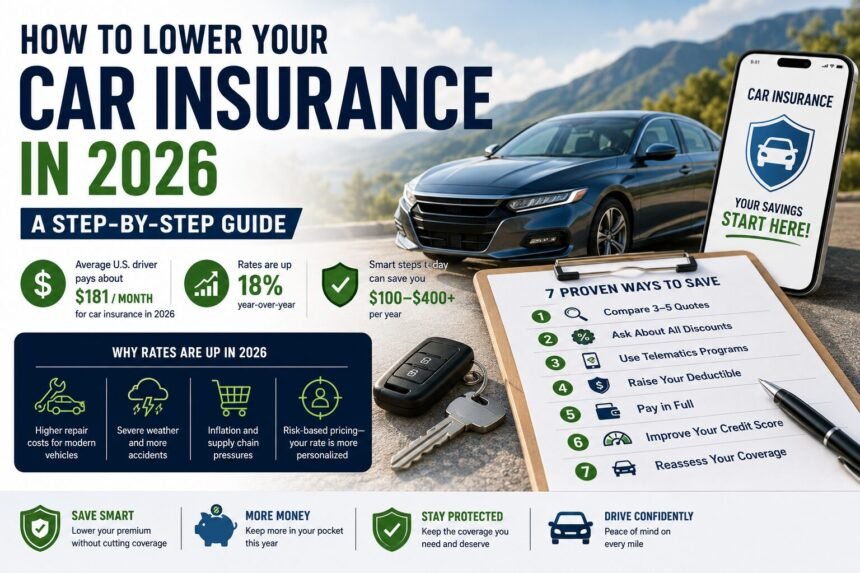
How to Lower Your Car Insurance in 2026: A Step-by-Step Guide
How to Lower Your Car Insurance in 2026: The average U.S. driver now pays about $181 a month for car insurance — an 18% jump from last year, on top of a 12% increase the year before that. If your renewal notice just landed and the number made you wince, you’re not imagining it. Rates really have climbed sharply. The good news: there are concrete, provable ways to bring that number back down without gutting your coverage.
- Why Rates Are Up (Quick Context)
- How to Lower Your Car Insurance in 2026
- How to Lower Your Car Insurance in 2026
- Step 1: Get Quotes From at Least 3–5 Providers Before You Renew
- Step 2: Ask About Every Discount You Might Qualify For
- Step 3: Consider a Usage-Based or Telematics Program
- Step 4: Raise Your Deductible (If You Have the Cash Cushion For It)
- Step 5: Pay Your Premium in Full, Not in Installments
- Step 6: Improve Your Credit Score
- Step 7: Reassess Your Coverage Level — Don’t Just Cut It
- How to Lower Your Car Insurance in 2026 – Quick Recap
Why Rates Are Up (Quick Context)
Before the fixes, it helps to know what’s actually driving this:
- Repair costs have risen — modern vehicles, including EVs and hybrids, are loaded with sensors and computer systems, so even a minor fender bender can trigger an expensive, specialized repair.
- Severe weather and accident frequency have both increased claims volume.
- Inflation and supply chain disruption have pushed up the cost of parts, labor, and replacement vehicles.
- Insurers are shifting toward risk-based pricing — meaning rates are increasingly personalized to your specific profile rather than broad, uniform hikes. That’s exactly why shopping around now matters more than it used to.
None of this is something you personally caused, and none of it is something you can undo — but the steps below target the parts of your premium that actually are in your control.
How to Lower Your Car Insurance in 2026
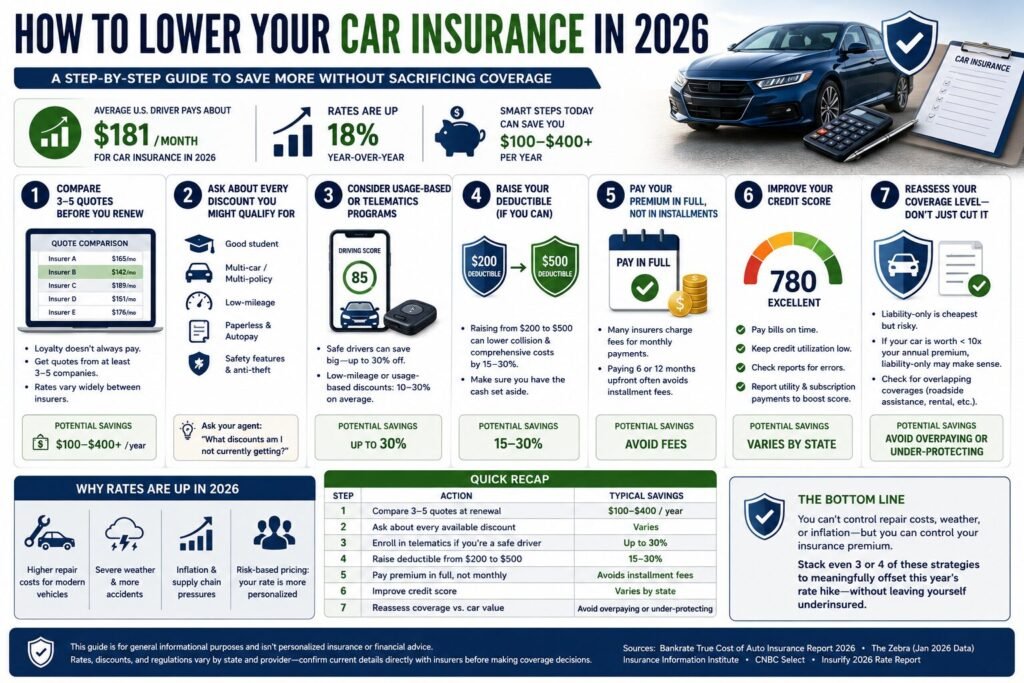
How to Lower Your Car Insurance in 2026
Step 1: Get Quotes From at Least 3–5 Providers Before You Renew
This is the single highest-leverage step, and most people skip it out of habit.
- Staying loyal to the same insurer does not automatically mean you’re getting the best rate — insurers frequently adjust pricing for new customers differently than renewals.
- Get quotes from at least three to five companies for the same coverage level, every time your policy comes up for renewal.
- Shopping around every year or two can realistically save $100–$400 annually, and rate changes vary significantly between companies — some carriers are lowering rates in 2026 while others are raising them by double digits, so the “best” insurer this year may not be who you’re with now.
Step 2: Ask About Every Discount You Might Qualify For
Insurers offer far more discounts than most policyholders realize, and they’re rarely applied automatically. Ask specifically about:
- Good student discounts
- Multi-car or multi-policy (bundling home + auto) discounts
- Low-mileage discounts — accurate mileage reporting alone can qualify you for savings
- Paperless billing and autopay discounts
- Safety feature discounts (anti-theft systems, advanced driver-assist features)
When in doubt, call your agent directly and ask, “What discounts am I not currently getting?” — this single question surfaces savings that quote comparison sites sometimes miss.
Step 3: Consider a Usage-Based or Telematics Program
If you’re a genuinely safe or low-mileage driver, telematics programs (which track driving behavior via an app or device) can unlock meaningful savings — some programs offer up to 30% off, and low-mileage or usage-based discounts commonly land in the 10–30% range.
Before enrolling, be clear-eyed about the trade-off: these programs share your driving data with the insurer. If you’re comfortable with that in exchange for the discount, it’s one of the larger single levers available.
Step 4: Raise Your Deductible (If You Have the Cash Cushion For It)
Your deductible is what you pay out of pocket before insurance kicks in. Raising it lowers your premium — but only take this step if you genuinely have that amount set aside.
- Raising a deductible from $200 to $500 can reduce collision and comprehensive coverage costs by 15–30%.
- This is a good pairing with the emergency fund guide on this site — if you already have a $500–$1,000 starter emergency fund, a higher deductible becomes low-risk instead of a gamble.
Step 5: Pay Your Premium in Full, Not in Installments
Many insurers charge a fee for splitting your premium into monthly payments. Paying your 6-month or 12-month premium upfront, if you’re able to, often functions as an automatic discount simply by avoiding that installment fee.
Step 6: Improve Your Credit Score
In most states, insurers factor credit history into your rate — the logic being that credit history correlates statistically with the likelihood of filing a claim. Improving your score can lower your premium over time:
- Pay bills on time and keep credit utilization low — the two fastest levers for score improvement.
- Check your credit report for errors, which are more common than people expect and can be disputed.
- Services that report on-time utility or subscription payments (not normally visible to credit bureaus) can give your score a boost without taking on new credit.
Step 7: Reassess Your Coverage Level — Don’t Just Cut It
It’s tempting to drop to minimum liability coverage to save money, but that’s not always the smarter move.
- Liability-only is the cheapest option, but it leaves you financially exposed if you’re at fault in an accident.
- A reasonable rule of thumb: if your car’s value is less than 10 times your annual premium, liability-only may genuinely make sense. Otherwise, full coverage is usually worth the extra cost.
- Check whether you already have overlapping coverage elsewhere — some credit cards and AAA memberships already include roadside assistance or rental car reimbursement, meaning you might be paying twice for the same protection.
How to Lower Your Car Insurance in 2026 – Quick Recap
| Step | Action | Typical Savings |
|---|---|---|
| 1 | Compare 3–5 quotes at renewal | $100–$400/year |
| 2 | Ask about every available discount | Varies |
| 3 | Enroll in telematics if you’re a safe driver | Up to 30% |
| 4 | Raise deductible from $200 to $500 | 15–30% |
| 5 | Pay premium in full, not monthly | Avoids installment fees |
| 6 | Improve credit score | Varies by state |
| 7 | Reassess coverage vs. car value | Avoid overpaying or under-protecting |
Rising car insurance costs in 2026 are largely driven by factors outside your control — repair costs, weather, inflation. But the steps above target the part of the equation that is in your control, and stacking even three or four of them can meaningfully offset this year’s rate hike without leaving you underinsured.
This guide is for general informational purposes and isn’t personalized insurance or financial advice. Rates, discounts, and regulations vary by state and provider — confirm current details directly with insurers before making coverage decisions.
Sources: Bankrate True Cost of Auto Insurance report, The Zebra January 2026 data, Insurance Information Institute, CNBC Select, Insurify 2026 rate report.