

How to Build an Emergency Fund in 2026: A Step-by-Step Guide (Even If You’re Starting From $0)
How to Build an Emergency Fund in 2026, emergency fund step by step, how much should be in an emergency fund 2026, high-yield savings account emergency fund.
- How to Build an Emergency Fund in 2026
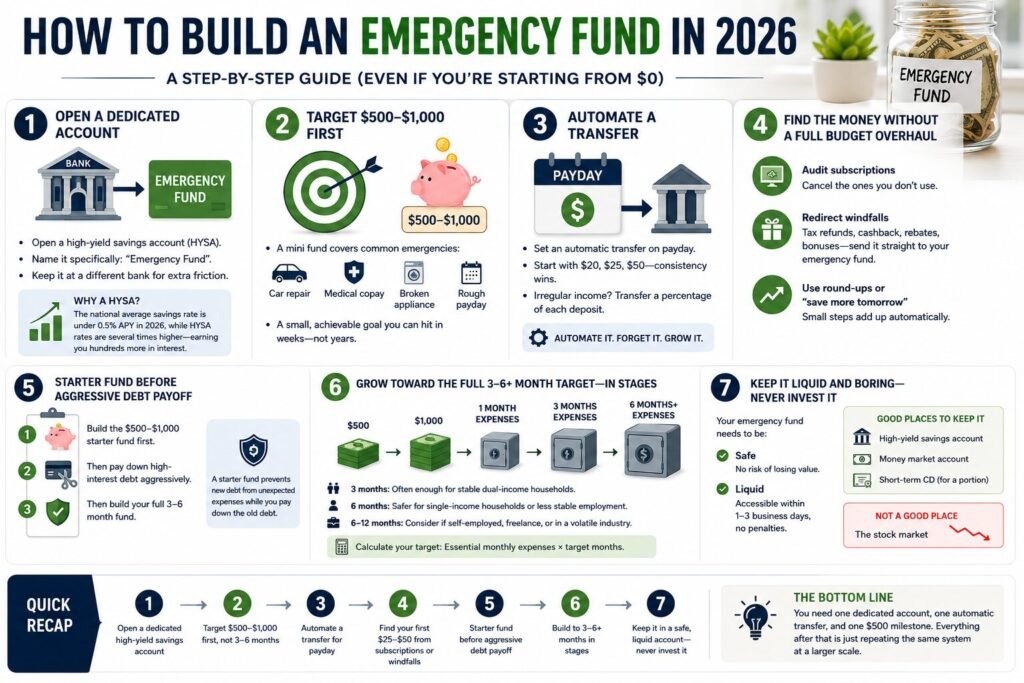
- Step 1: Open a Dedicated Account (Before You Have Any Money Saved)
- Step 2: Set Your First Real Goal at $500–$1,000 (Not 3–6 Months)
- Step 3: Automate a Transfer on Payday
- Step 4: Find the Money Without a Full Budget Overhaul
- Step 5: Decide Debt vs. Savings — Don’t Try to Do Both Fully at Once
- Step 6: Grow Toward the Full 3–6 Month Target — In Stages
- Step 7: Keep It Liquid and Boring — Never Invest Your Emergency Fund
- Quick Recap
59% of Americans currently can’t cover a $1,000 emergency without borrowing. If that’s you right now, this guide isn’t going to tell you to save six months of expenses overnight — that’s not realistic advice, it’s just discouraging. Instead, here’s the exact sequence that works whether you’re starting with $0 or $200.
How to Build an Emergency Fund in 2026
Step 1: Open a Dedicated Account (Before You Have Any Money Saved)
Don’t wait until you have savings to open the account — open it first, then fill it.
- Open a high-yield savings account (HYSA), separate from your everyday checking account.
- Name it something specific, like “Emergency Fund” — this small step makes it harder to justify tapping it for non-emergencies.
- Keep it at a different bank than your checking account if possible. The extra friction of transferring between banks (instead of one tap within the same app) meaningfully reduces impulse withdrawals.
Why a HYSA specifically: the national average savings account rate has been sitting under 0.5% APY in 2026, while high-yield accounts have been offering rates several times higher. On a $10,000 balance, that difference can mean hundreds of dollars a year in interest — money that grows your safety net without any extra effort from you. Compare current rates before choosing, since they shift with the Fed’s rate decisions.
Step 2: Set Your First Real Goal at $500–$1,000 (Not 3–6 Months)
Forget the “3 to 6 months of expenses” number for now — that’s the long-term target, not the starting line.
A $500–$1,000 mini emergency fund is specifically sized to cover the most common real-world emergencies: a car repair, a co-pay, a broken appliance, one rough pay period. This single milestone is what closes the exact gap that leaves the majority of Americans exposed today.
Why this matters more than the bigger number: a small, achievable goal is something you can actually hit in weeks, not years — and hitting it proves the system works, which makes the next stage easier.
Step 3: Automate a Transfer on Payday
This is the step most people skip, and it’s the one that actually determines whether the fund gets built.
- Set up an automatic transfer from checking to your emergency fund for the day your paycheck lands — not a manual transfer you’ll “get to.”
- Start with whatever is realistic: $25, $50, even $20. Consistency beats amount at this stage.
- If your income is irregular (freelance, gig work, commission-based), automate a percentage of each deposit instead of a fixed dollar amount, so it scales with what you actually earn.
Step 4: Find the Money Without a Full Budget Overhaul
You don’t need a perfect budget to find your first $25–$50. A few realistic sources:
- Audit subscriptions. The average person pays for several they barely use — canceling even one or two often covers a full transfer.
- Redirect windfalls. Tax refunds, cashback rewards, rebates, or a small bonus — send it straight to the emergency fund instead of your checking account.
- Round-up or “save more tomorrow” tricks. Many banking apps round up purchases to the nearest dollar and sink the difference into savings automatically. Alternatively, increase your automatic transfer by 1% every few months so it grows without feeling like a sudden cut to your spending.
Step 5: Decide Debt vs. Savings — Don’t Try to Do Both Fully at Once
If you’re also carrying credit card debt (true for a majority of Americans right now), trying to aggressively pay down debt and build a full emergency fund at the same time usually stalls both.
The generally recommended order:
- Build the $500–$1,000 starter fund first, even while carrying some debt.
- Then shift focus to paying down high-interest debt aggressively.
- Once high-interest debt is cleared, return to building the full 3–6 month fund.
This order exists because a starter fund prevents new debt from unexpected expenses while you’re paying down the old debt — without it, one car repair can undo months of debt payoff progress.
Step 6: Grow Toward the Full 3–6 Month Target — In Stages
Once your starter fund and debt are under control, build toward the larger goal in clear stages rather than one intimidating number:
$500 → $1,000 → one month of essential expenses → three months → six months
- 3 months is often enough if you have stable dual-income household finances and low job-loss risk.
- 6 months is the safer target for single-income households or less stable employment.
- 6–12 months is worth considering if you’re self-employed, freelance, or in a volatile industry — where income itself is less predictable, not just expenses.
To estimate your target in dollars: multiply your essential monthly expenses (housing, utilities, groceries, insurance, minimum debt payments — not discretionary spending) by your target number of months.
Step 7: Keep It Liquid and Boring — Never Invest Your Emergency Fund
It’s tempting to chase higher returns by putting emergency savings into stocks once the balance grows. Don’t.
Your emergency fund has exactly two requirements:
- Safe — no risk of losing value.
- Liquid — accessible within 1–3 business days, no penalties.
Stocks fail the first requirement — markets can drop sharply at the same time job losses spike, which is precisely when you’re most likely to need the fund. A high-yield savings account, money market account, or short-term CD (for a portion of a larger fund only) are appropriate; the stock market is not.
Quick Recap
| Step | Action |
|---|---|
| 1 | Open a dedicated high-yield savings account |
| 2 | Target $500–$1,000 first, not 3–6 months |
| 3 | Automate a transfer for payday |
| 4 | Find your first $25–$50 from subscriptions or windfalls |
| 5 | Starter fund before aggressive debt payoff |
| 6 | Build to 3–6+ months in stages |
| 7 | Keep it in a safe, liquid account — never invest it |
You don’t need a perfect budget, a big raise, or six months of expenses saved to start. You need one dedicated account, one automatic transfer, and one $500 milestone. Everything after that is just repeating the same system at a larger scale.
This guide is for general informational purposes and isn’t personalized financial advice. Savings account rates and terms change frequently — compare current offers before opening an account, and consider speaking with a licensed financial advisor for advice specific to your situation.
Sources: Bankrate 2026 Emergency Savings Report, U.S. News Personal Finance, Kiplinger, FDIC deposit insurance data.